Basically it has to do with the line of balance, the line of action, etc. Andrew Loomis goes over it in his book. Following are the titles of some of the chapters in his book- The Standing Figure; The Figure in Action: Turning and Twisting; Forward Movment: The Tipped Line of Balance; Balance, Rhythm, Rendering; The Kneeling, Crouching, Sitting Figure, and The Reclining Figure.
The Greeks are the ones who discovered it. What it means is, if you put your weight on one leg so your pelvis side bearing the weight tips higher and your torso counters that so that your clavicles (collar bones are almost exactly at the opposite angle). From the top of your sternum, also called the supra-sternal notch, and commonly referred to as the pit of the neck, the line of balance goes straight down and will fall on the foot with the weight bearing leg. If you had your weight evenly distributed on two legs than the line of balance would fall between your two legs right in the middle. If you were leaning your weight on something, for instance, a lamp-post, part of your weight would be on the pole so your line of balance would shift over beyond your foot that is bearing the weight.
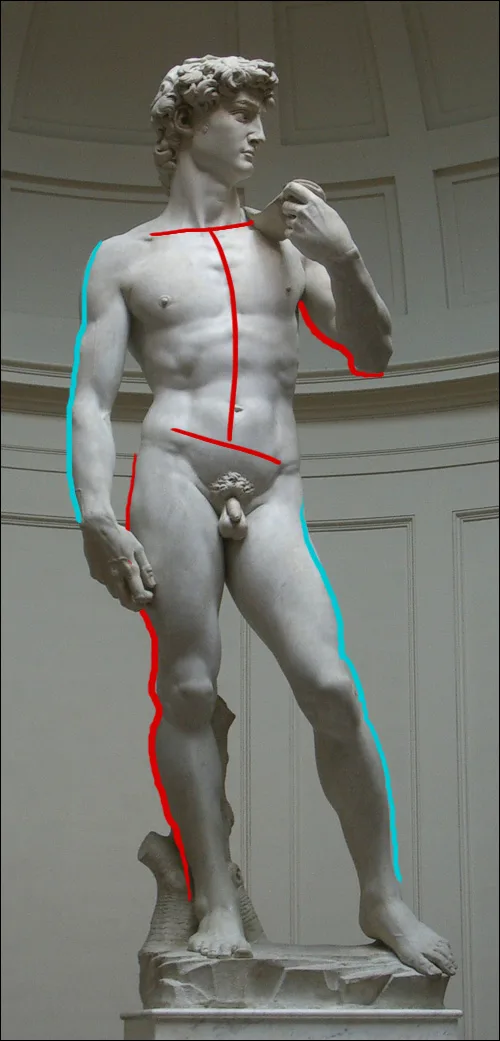
Michelangelo’s David