I first learned of this artist when I saw his painting on the cover of American Artist magazine (when it existed) in January of 2011. What caught my attention was two things, the liveliness of the painting itself and secondly, the subject matter which was an urban scene – not only an urban scene, but one of New York city itself, a subject matter which would go without saying, is one which I am familiar with and fond of. My further investigation revealed that he is indeed a talented artist and one who is not limited to the particular genre of cityscapes. In fact, his figurative work is equally exciting.
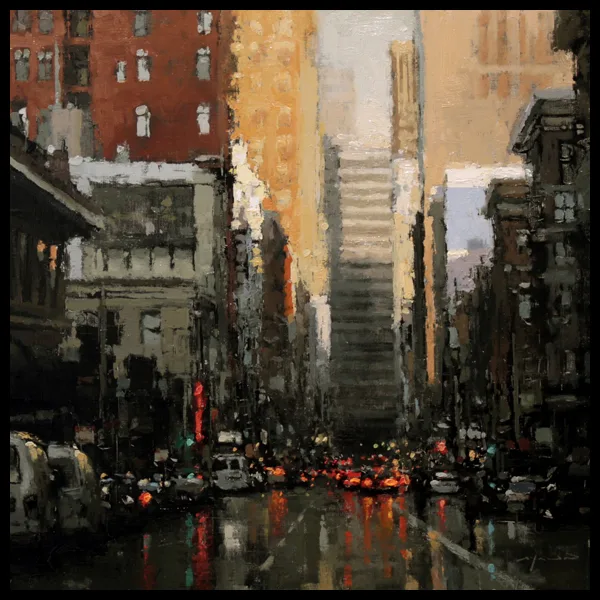
In the magazine, the artist stated that he enjoyed working in various genres to keep his interest level and creativity up. Also he has an interesting take on materials, seeking to apply paint in a rough matter and circumventing the use of brushes if possible.
“I believe no artist cam truly create without allowing every avenue of artistic endeavor to be at his or her fingertips so that none should be pigeon-holed as a ‘figure paitner’ or ‘cityscape painter’ but simply ‘a painter’ or even just ‘an artist.’ The multip directions I jump in are out of are all important to my progression as an artist’ they tend to feed off one another and happily end up converging at some points and shooting off in completely separate directions at others.”
When painting a landscape, Mann finds that starting on location helps fuel his work in the studio. “I like the silence and study of plein air painting,” he says, “and I use the ‘feeling’ I capture in those studies to imbue my work with a fresh impression. I spend a lot of tim making sketches, color studies, compositions, and arrangements before I attack the surface so that I can rely on my subconscious knowledge of the formalities while letting my personal ideals take over during the actual painting process.”
Mann builds his paintings in multiple layers. “I always start with an underpainting that could survive as a finished piece alone,’ the artist explains. “I challenge myself to destroy and reinvigorate that piece while adding to it.” The process of building the painting is very important to the artist, and his technique incorporates an approach that makes this more dramatic. “I paint on panels, mostly because they can suffer the malicious attack I impose upon them,” he says, “but I’ve come to understand that the many qualities of a rough, hard surface work best with my appreciation of beauty. I try very hard to not use brushes, or at least one or two very shattered ones if any. Most of my compositions and first stages are done with rubber brayers, rags, knifes, fingers, metal poles-whatever it takes. The rest of my work comes with only a brush or two, glazes and rollers, and more recently, palette-knife techniques that don’t immediately resemble the usual use of a knife.”
“I don’t believe a painting should look like it was easily created, and the best way to do that is to use objects that remove oneself from the effect, therefore relying more on what the artist knows than on the typical tools of the trade. When people stop wondering how it was made, they can begin to appreciate why it was created in the first place.”
Have a look at his website to see more examples of his work.